
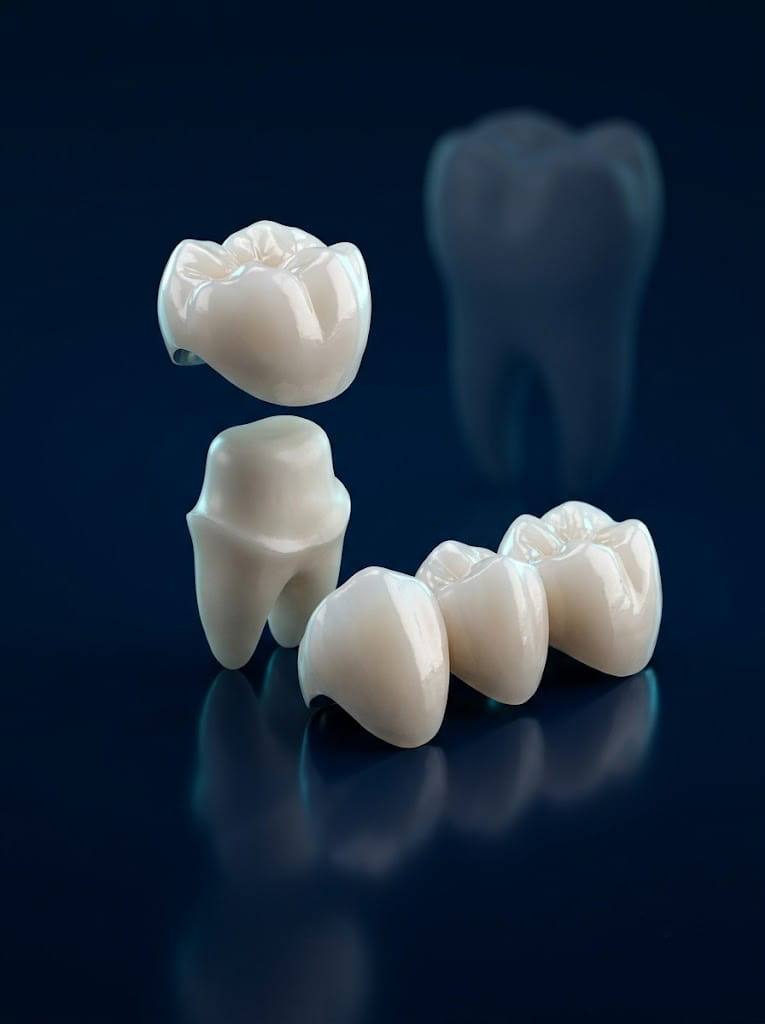
Understanding the Dental Bridge
A dental bridge is a fixed prosthetic device consisting of an artificial tooth (called a pontic) suspended between two dental crowns. The crowns are cemented onto the natural teeth on either side of the gap (the abutment teeth). To accommodate the crowns, the abutment teeth must be prepared — a process that involves permanently reducing their size by removing a significant amount of healthy tooth structure, typically 1 to 2 millimetres from all surfaces.
Once the bridge is cemented, it is a fixed, non-removable restoration that looks natural and functions well for chewing and aesthetics. Bridges can be made from porcelain fused to metal, zirconia, or full ceramic, and when well-made, can look very natural. The procedure is completed in two or three appointments: preparation, impression, temporary bridge, and fitting of the permanent bridge.
Understanding the Single Tooth Implant
A dental implant for a single missing tooth consists of:
- A titanium implant post placed surgically into the jawbone at the site of the missing tooth
- An abutment connected to the implant post
- A porcelain or ceramic crown placed on the abutment
No adjacent teeth are involved in any way. The implant is completely self-supporting, anchored entirely in the bone at the missing tooth site.
The procedure takes longer than a bridge — the implant must osseointegrate (fuse with the bone) for 2 to 4 months before the crown can be placed — but the end result is a single tooth restoration that is independent of all surrounding teeth. Because the implant replaces the tooth root, it also stimulates the jawbone at the missing tooth site, preventing the bone loss that inevitably follows extraction.
The Sacrifice of Adjacent Teeth — The Most Important Difference
The most significant clinical disadvantage of a dental bridge is the permanent alteration of two healthy adjacent teeth. To support the bridge, these teeth must be filed down to stumps — often removing 60 to 70 per cent of the original tooth structure. These teeth are permanently weakened and entirely dependent on the bridge structure going forward. They cannot be un-prepared. If the bridge fails or needs replacement, the prepared abutment teeth may no longer have sufficient structure to support a new bridge, limiting future treatment options.
A dental implant leaves adjacent teeth completely untouched. They remain fully intact, fully independent, and unaffected by the implant procedure. This is why most implant-trained dentists in Ranchi will recommend a single tooth implant over a bridge when a patient is a suitable candidate — the decision to file down two healthy teeth for the sake of replacing one missing tooth is a permanent sacrifice that carries long-term consequences.
Bone Preservation — A Long-Term Consideration
After a tooth is extracted, the bone that surrounded the root begins to resorb within weeks. Over the first year after extraction, bone volume in the area decreases by approximately 25 per cent. This resorption continues over subsequent years, though at a slower rate. A dental bridge does not address this bone loss — the pontic (artificial tooth) sits above the gum and transmits no force to the underlying bone.
A dental implant placed in the extraction site provides the same type of bone stimulation as a natural tooth root. Bone resorption is halted, and the bone volume in the area is maintained long-term. This bone preservation matters for more than aesthetics — it affects the long-term stability of adjacent teeth, prevents the sunken appearance that prolonged bone loss can cause at the gum line, and ensures that future dental options remain open.
Comparing Longevity and Durability
Dental bridges have a lifespan of approximately 10 to 15 years before they typically need replacement due to normal wear, changes in the bite, or deterioration of the cement bond. Some bridges last longer with excellent care; some fail earlier if the abutment teeth develop new decay beneath the crowns.
Dental implants placed by an experienced implant dentist in Ranchi, and maintained with good oral hygiene, can last decades. Many implants placed in the 1980s and 1990s — when implant technology was considerably less refined than today — are still functioning. The crown on an implant typically needs replacement after 15 to 20 years due to wear, but the implant post itself often lasts a lifetime.
Maintenance and Oral Hygiene Comparison
A dental bridge requires specific hygiene attention because the pontic prevents normal flossing between the bridged teeth. Patients must use a floss threader or interdental brush to clean beneath the pontic, where plaque accumulates and can cause decay in the abutment teeth and gum inflammation. If this maintenance is neglected, decay can develop under the bridge crowns, leading to bridge failure.
A dental implant is maintained like a natural tooth — standard brushing and flossing, with floss passed around the implant crown. There is no need for special threading tools or modified technique. Regular professional cleaning at dental check-ups addresses any areas that require attention. The simplicity of implant maintenance is one of its underappreciated practical advantages.
Cost — Upfront vs Long-Term
In the short term, a dental bridge generally costs less than a dental implant. This leads many patients to choose a bridge for financial reasons, which is a completely understandable decision. However, the full financial picture over 20 years is more nuanced. A bridge will require replacement — typically at least once, possibly twice, in a patient's lifetime. Each replacement involves new preparation of the abutment teeth and all associated laboratory and clinical costs.
An implant requires a higher upfront investment but minimal ongoing cost beyond regular dental maintenance. When the total cost over 15 to 20 years is calculated, implants are frequently the more economical option — particularly when the cost of managing complications from failed bridges or abutment tooth decay is included.
When Is a Bridge the Right Choice?
Despite the advantages of implants, there are clinical situations where a bridge is the more appropriate choice. When the bone volume at the extraction site is severely depleted and the patient is not suitable for bone grafting, an implant may not be possible. When the adjacent teeth already require crowns for independent reasons — for example, large existing fillings or previous damage — using those teeth as bridge abutments makes clinical sense, since they are being crowned regardless.
Patient health is also a factor. Certain medical conditions or medications can increase implant failure risk significantly, making a bridge the safer surgical alternative. A thorough assessment by an experienced implant dentist in Ranchi will identify which option is more appropriate for each patient's specific clinical situation.
Conclusion
For most patients with a single missing tooth who are healthy enough for implant surgery and have adequate bone at the extraction site, a single tooth dental implant is the superior long-term solution — it preserves adjacent teeth, maintains bone volume, and lasts longer. To discuss which option is right for your specific situation, book a consultation with Dr. Praveen Kumar at Perfect 32 in Ranchi. Call +91 6204522473.