
What Exactly Is a Dental Implant?
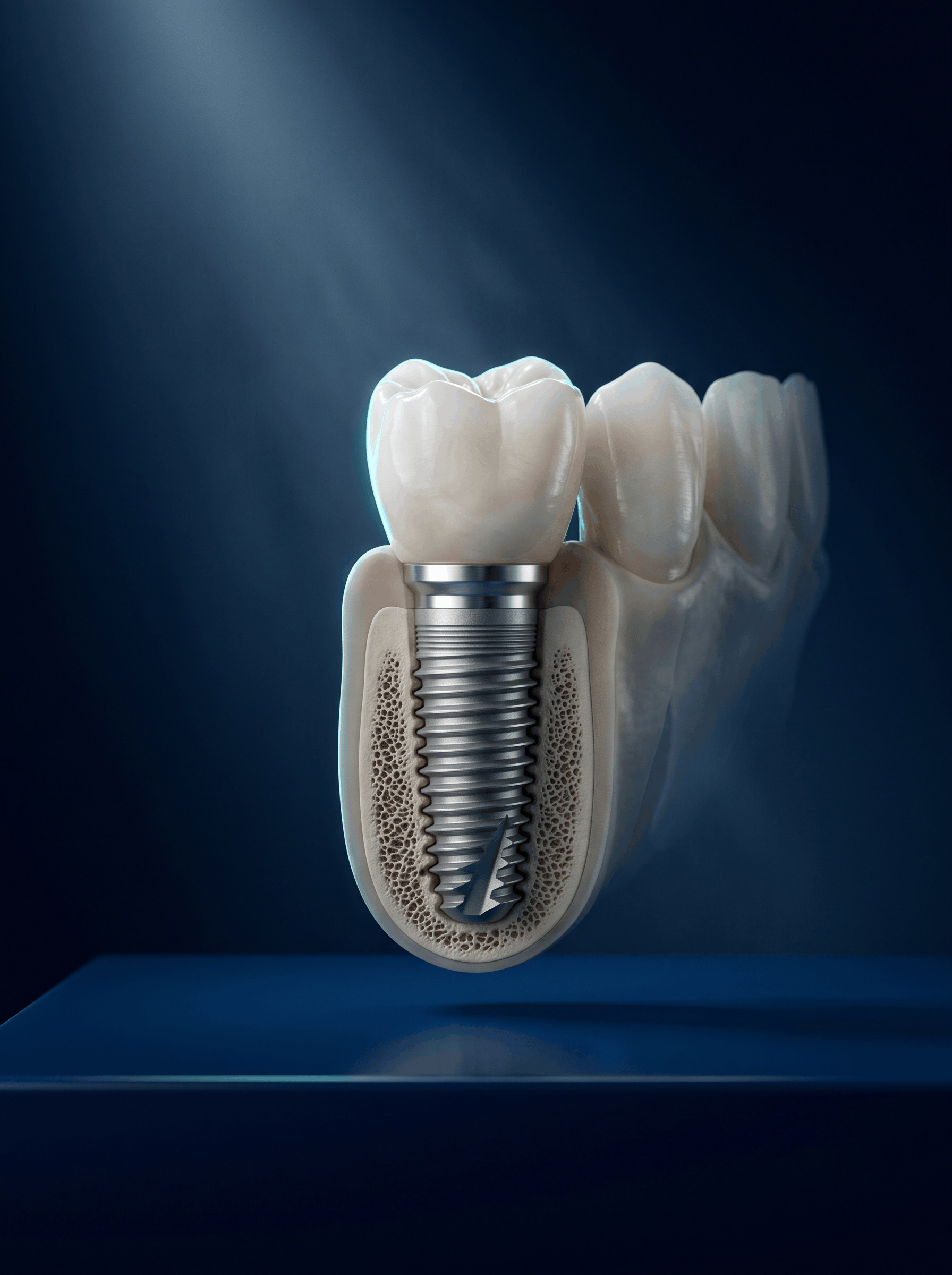
A dental implant is a small titanium post — typically between 3.5mm and 5mm in diameter and 8mm to 16mm in length — that is surgically inserted into the jawbone in the position of a missing tooth. Titanium is used because it is biocompatible: the body does not reject it, and over a period of 2 to 4 months following placement, the bone grows around and fuses to the implant surface in a process called osseointegration. Once this fusion is complete, the implant is as firmly anchored in the jaw as a natural tooth root.
Attached to this fused post is an abutment — a small connector piece — and on top of the abutment sits the crown: a custom-made ceramic or porcelain-fused-to-metal tooth that is colour-matched to your surrounding natural teeth. The result, when placed correctly by an experienced implant dentist, is indistinguishable from a natural tooth in appearance, and functionally identical in terms of biting force, stability, and comfort.
How Are Dental Implants Different From Other Tooth Replacements?
The fundamental difference between a dental implant and any other tooth replacement option — dentures, bridges, partial plates — is that an implant replaces the tooth root, not just the crown. This distinction matters enormously. The tooth root stimulates the jawbone every time you bite or chew. When a tooth is lost and the root is not replaced, this stimulation stops, and the bone in that area gradually resorbs — it shrinks and loses density over months and years.
Dentures and bridges rest on top of the gum or anchor to adjacent teeth. They do not stimulate the underlying bone, so bone resorption continues beneath them. Over time, this bone loss changes the shape of the jaw, causes dentures to become loose and ill-fitting, and can affect the appearance of the face. A dental implant stops bone resorption entirely by providing the same kind of functional load to the bone that a natural root would. This is why implants are not merely the cosmetically superior option — they are medically superior for long-term jaw health.
Who Is a Good Candidate for Dental Implants?
The ideal dental implant candidate is a healthy adult with one or more missing teeth, sufficient bone volume and density in the area where the implant is to be placed, healthy gum tissue free from active periodontal disease, and no systemic conditions that significantly impair healing. Most adults who have lost teeth to decay, injury, or gum disease are suitable candidates.
Certain conditions call for careful consideration before implant placement, including:
- Uncontrolled diabetes (which impairs healing and increases infection risk)
- Bisphosphonate medication use (which affects bone metabolism)
- Active smoking (which significantly increases implant failure rates)
- A history of radiation therapy to the head and neck area
None of these are automatically disqualifying, but they require thorough pre-treatment assessment by an experienced implant dentist in Ranchi.
When Bone Loss Has Already Occurred — Bone Grafting
A significant proportion of patients who seek dental implants in Ranchi have had missing teeth for some time, meaning bone resorption has already occurred. If the bone volume at the implant site is insufficient to safely place and support an implant, a bone graft procedure is required first. This involves adding bone material to the deficient site — either from the patient's own body, from a donor source, or using synthetic bone substitute materials.
Bone grafting adds to the overall treatment timeline, typically requiring 3 to 6 months of healing before implant placement can proceed. However, it makes implants possible in many patients who would otherwise not be candidates. A thorough pre-implant assessment, including a CBCT scan (cone beam CT) for accurate three-dimensional bone mapping, allows the implant dentist to determine exactly what preparation is required.
The Dental Implant Procedure — Stage by Stage
Stage 1 — Consultation and planning: The implant dentist takes detailed X-rays or a CBCT scan, assesses bone volume and density, evaluates gum health, reviews medical history, and formulates a precise treatment plan. The timing, position, diameter, and length of the implant are planned before any surgery takes place.
Stage 2 — Implant placement: Under local anaesthesia, the gum is opened and the implant site is prepared using a sequential set of drills to the precise planned dimensions. The implant is then seated in the prepared site and the gum is closed with sutures. The procedure is typically performed in 30 to 60 minutes and is well-tolerated under local anaesthesia. Post-operative discomfort is usually mild to moderate and manageable with standard pain relief.
Osseointegration and the Healing Period
After placement, the implant is left to heal for 2 to 4 months. During this period, the bone forms a direct structural and functional connection with the implant surface — this is osseointegration. The implant is not loaded (no chewing force placed on it) during this period. A temporary tooth replacement may be provided to maintain appearance and function while healing occurs.
At the end of the healing period, your implant dentist will confirm osseointegration through examination and X-ray. If the implant is fully integrated, the abutment is attached and impressions or digital scans are taken for the fabrication of your final crown. The crown is typically fitted 2 to 3 weeks after these impressions are taken.
Caring for Your Dental Implant Long-Term
Dental implants are maintained exactly as you would maintain natural teeth: brushing twice daily, flossing daily (including around the implant), and attending regular dental check-ups every six months. Professional cleaning of the implant surface is included in these check-up appointments. Implants can develop a condition called peri-implantitis — an infection of the tissue around the implant similar to gum disease — if oral hygiene is neglected. This is the primary cause of late implant failure and is entirely preventable with good home care and regular professional monitoring.
Why the Implant Dentist's Qualifications Matter Most
Dental implant placement is a surgical procedure with a skill-dependent outcome. The position, angle, and depth of implant placement directly determine the aesthetic result, the long-term stability of the implant, and the patient's comfort during and after the procedure. An implant placed incorrectly — too close to a nerve, at the wrong angle, or in insufficient bone — can fail, cause nerve damage, or require complex corrective surgery.
Dr. Praveen Kumar at Perfect 32 holds an MDS in Prosthodontics and Implantology — a specialist postgraduate qualification covering both the surgical placement of implants and the restorative phase of treatment. This dual expertise in surgery and restoration is the gold standard for implant practice, ensuring that the implant is placed with the final aesthetic and functional outcome as the primary guide. For patients seeking the best implant dentist in Ranchi, this combination of qualifications and clinical experience is a significant differentiator.
Conclusion
Dental implants offer a permanent, natural-feeling, bone-preserving solution for missing teeth that no other treatment can match. For patients in Ranchi, Perfect 32 Dental Clinic and Implant Centre provides specialist implant care with the expertise of Dr. Praveen Kumar, MDS Prosthodontics and Implantology. Call +91 6204522473 or visit perfect32ranchi.com to book your implant consultation.